
series: AI from zero to expert | article 2 of 30I ask myself if this time AI is different, if the 2026 hype is going to last. And every time, I remember this question has already been asked before. Twice, actually, and both times the answer was no, the money ran out and the labs pulled down the shutters. This chapter is the story of those two times: the so-called “AI winters,” the periods when the field promised too much, delivered too little, and paid the price in zero funding.
Knowing this history isn’t a nostalgia exercise. It’s a vaccine against hype: if you know why the lights went out twice before, you can judge with more clarity whether this time is different, and you’ll sound a lot better informed the next time someone tells you generative AI is going to change everything by tomorrow.
1950: the question that started it all
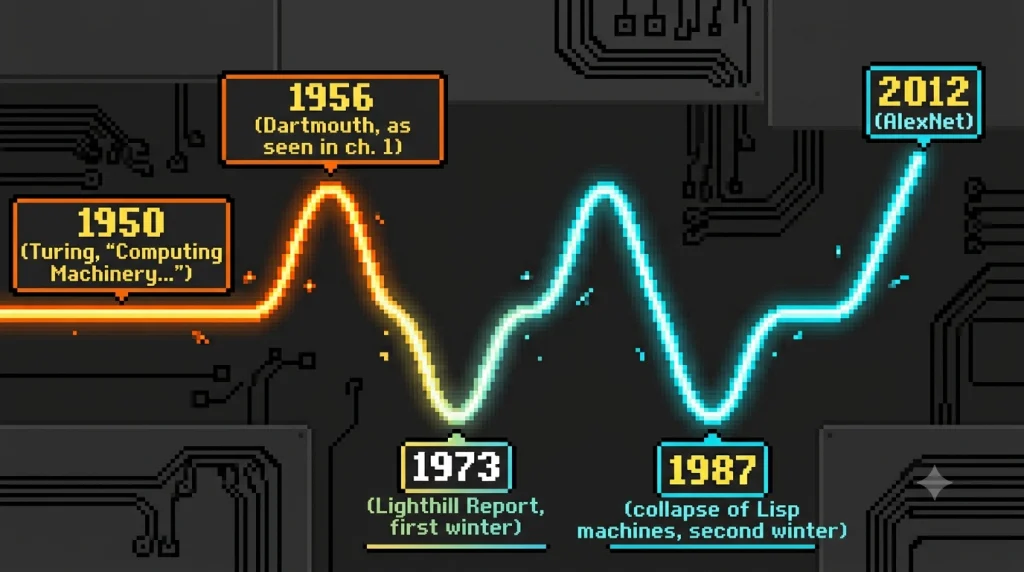
Before the term “artificial intelligence” existed (that came in 1956, as we saw in the last chapter), Alan Turing published a paper that’s still required reading: “Computing Machinery and Intelligence,” in the journal Mind, in 1950. Turing doesn’t ask “can machines think?” because he considers the question too ambiguous to answer seriously. Instead, he proposes a game: the “imitation game” (known today as the Turing test), where a human interrogator blindly converses with a machine and with another human, without knowing which is which. If the interrogator can’t reliably tell them apart, the machine “passes” the test.
Turing even put a date and a number on it. He wrote that he believed in about fifty years it would be possible to program computers well enough to play the imitation game so convincingly that an average interrogator wouldn’t have more than a 70% chance of correctly identifying which was which after five minutes of questioning. Translated: by the year 2000, an interrogator should be fooled at least 30% of the time. The year 2000 came and went, and no system hit that mark. AI’s very first prediction already carried its first letdown inside it.
Seventy-five years after that paper, we’re still arguing over whether any system has truly passed that test, and we’re still using the framework Turing proposed to ask the question. That’s what separates a founding paper from a passing trend: staying power.
And here’s the full-circle data point. In 2024, a team of researchers at UC San Diego reproduced Turing’s experiment almost to the letter: around 500 people had five-minute text conversations, not knowing whether they were talking to a human or a system. GPT-4 was identified as human in 54% of the conversations, higher than ELIZA, a 1960s chatbot used as a control that only fooled 22%, though still below the 67% real humans scored pretending to be human. Turing had set the bar at 30% confusion by the year 2000. It arrived 24 years late, but it arrived, and by a wide margin.
One caveat before celebrating on AI’s behalf: passing the Turing test shows a system can imitate a human conversation well for five minutes, not that it thinks, understands, or is conscious in any deep sense of those words. Turing designed the game precisely to sidestep that philosophical question, not to answer it. It’s a test of behavior, not of inner nature, a distinction I’ll come back to in phase 3 of this series.
1956-1973: the early euphoria
With the term freshly coined at Dartmouth, the first years of AI as a formal field were marked by nearly unlimited optimism, and I don’t mean that figuratively: I mean specific dates and percentages, published by the field’s own founders, that didn’t come close to holding up. In 1965, Herbert Simon, one of the attendees at the Dartmouth workshop and a future Nobel laureate, wrote that machines would be capable, within twenty years, of doing any work a human could do. Marvin Minsky, another founding father of the field, went even further: in 1967 he predicted that within a generation the problem of creating artificial intelligence would be substantially solved, and in a 1970 Life magazine interview he got even more specific, claiming that within three to eight years we’d have a machine with the general intelligence of an average human.
None of those three predictions held up within the promised timeframe. And this pattern (promising a specific, very near date for an achievement that would actually take decades, or hasn’t arrived yet) is exactly the mechanism that a couple of years later started costing the entire field.
One of the first blows to that optimism came from a very specific angle: machine translation. In 1966, the ALPAC committee, commissioned by the US government to evaluate progress in machine translation after years of investment, published a damning report: machine translation wasn’t living up to its promises, it was slower and more expensive than human translation, and there was no clear path to it improving soon. The result was the near-total end of public funding for machine translation research in the US for years.
ALPAC was the warning shot, limited to one subfield. What came next was the real blow, and this time it hit the entire field.
The first winter (1973-1980): the report that turned out the lights
In 1973, British mathematician Sir James Lighthill delivered a report commissioned by the UK’s Science Research Council to assess the state of AI research. Lighthill’s conclusion was harsh: most academic AI hadn’t delivered on its promises, and many of the problems the field was trying to solve suffered from what he called “combinatorial explosion,” the number of possibilities to explore grew exponentially the moment a problem stopped being a lab toy and approached real-world scale.
The Lighthill report had an immediate effect: the British government drastically cut AI research funding, leaving most UK universities without support for the field. The blow didn’t stay on British shores. The report became ammunition for skeptics worldwide, and contributed to DARPA in the US notably scaling back its support for AI research starting in 1974.
This period, roughly between 1973 and 1980, is what the community calls the first AI winter. The labs that survived did so on minimal budgets and much more modest expectations than Simon’s or Minsky’s a decade earlier.
The second winter (1987-1993): when AI hardware turned into scrap overnight
The 1980s brought a real comeback: expert systems. Programs built from hundreds or thousands of rules written by human specialists, like MYCIN, the medical diagnosis system you met in chapter 1, showed that AI could generate real commercial value in narrow domains. Entire companies were built around this idea, and with them came a market for specialized hardware: the so-called “Lisp machines,” computers designed specifically to run AI programs, sold by companies like Symbolics or LMI at prices far above a regular computer.
The problem was twofold. On one hand, expert systems turned out to be brittle and expensive to maintain: every update to the knowledge base required hiring a specialized engineer to rewrite rules by hand, a bottleneck known as the “knowledge acquisition problem.” An expert system didn’t learn anything new on its own, as you already saw in chapter 1: if the world changed, someone had to sit down and rewrite the rules. On the other hand, specialized hardware stopped making economic sense once general-purpose workstations, much cheaper, from companies like Apple or Sun Microsystems, matched its performance. The Lisp machine market crashed between 1987 and 1988.
The symbolic blow came from the US government itself: in 1987, Jack Schwartz, then head of DARPA’s information science office, dismissed expert systems as “clever programming” rather than real intelligence. Around the same time, Japan’s ambitious “Fifth Generation” computer project, chasing very similar goals with massive public funding, ended without reaching its targets. This second winter, which lasted roughly from 1987 to 1993, hit harder than the first because this time there was a real commercial industry behind it, with real jobs and investors to lose.
The ironic detail: deep learning’s seed was planted during the winter
Here’s my favorite data point in the whole chapter, the one that proves AI’s history is never as linear as it sounds when told in a hurry. In 1986, right as expert systems were peaking and just before the market crashed, David Rumelhart, Geoffrey Hinton, and Ronald Williams published a paper in Nature titled “Learning representations by back-propagating errors.” In it, they described the backpropagation algorithm, a method for training multi-layer neural networks by adjusting the weights of their connections to minimize the error between what the network predicts and what it should predict.
The technique that trains practically every deep learning model on the planet today, the same one you’ll see in detail in chapter 11, was published, literally, in the eye of the second AI winter’s storm. It didn’t have the compute power or the data needed to show its full potential in 1986. It had to wait 26 years, watching an entire winter pass, for the rest of the pieces to fall into place.
2012: the picture that thawed everything
Those pieces fell into place at the ImageNet Large Scale Visual Recognition Challenge, an annual competition where systems compete to correctly classify millions of photos into thousands of categories. Until that year, the best systems hovered around a 25-26% error rate, combining hand-designed image features with traditional statistical classifiers, the kind of classic AI you saw in chapter 1.
That year, a team made up of Alex Krizhevsky, Ilya Sutskever, and Geoffrey Hinton (the same Hinton from the 1986 paper) presented a system called AlexNet: an eight-layer deep neural network with about 60 million parameters, trained using backpropagation, but this time on GPUs and with access to millions of labeled images thanks to the ImageNet project itself. The result: a 15.3% error rate, an almost 11-percentage-point improvement over the second-best system in a single year of competition. The computer vision community was, literally, speechless.
AlexNet didn’t invent anything conceptually new: backpropagation had been published for 26 years, and convolutional networks had existed in academic papers for years too. What changed was that, for the first time, all three necessary ingredients existed at once for the idea to work at scale: massive labeled data, cheap compute power, and a well-tuned architecture. That moment, more than any other, marks the de facto end of the AI winters and the start of the decade that led, in a nearly straight line, to the language models you’ll see in phase 3 of this series.
Why this matters in 2026
The two winters, seen with hindsight, weren’t just bad luck. They share a pattern that repeats with variations: someone puts an optimistic, specific date on a problem that’s actually much harder than it looks from the outside, that date becomes the headline everyone repeats, and when the date arrives without the problem solved, the disappointment doesn’t stay contained to the missed milestone, it contaminates the credibility of the whole field, including the progress that was real. Simon didn’t lie on purpose. Neither did Minsky. Both genuinely underestimated the difficulty of the problem, something that still happens regularly today whenever someone puts a date on the arrival of artificial general intelligence.
The real difference between 2026 and 1973 or 1987 is that now there’s real revenue, products used by billions of people, and an economic ecosystem far more diversified than two university labs and a handful of government contracts. That doesn’t make a sharp correction to the current hype impossible. It just means that if it comes, it probably won’t look like the previous winters.
Next chapter, we leave history behind and go back to the map: what types of AI exist (narrow, general, superintelligence) and why almost everything we call “AI” today, including everything you just read in this chapter, falls, without exception, into the first category.
Sources
- Computing Machinery and Intelligence, A. M. Turing, Mind, 1950 (texto completo)
- The Turing Test (Stanford Encyclopedia of Philosophy)
- People cannot distinguish GPT-4 from a human in a Turing test (arXiv / ACM FAccT 2025)
- Quote Origin: Machines Will Be Capable, Within Twenty Years… (Quote Investigator, sobre Herbert Simon)
- Quote Origin: Within a Generation… the Problems of Creating Artificial Intelligence Will Be Substantially Solved (Quote Investigator, sobre Marvin Minsky)
- AI Winter: Understanding the Cycles of AI Development (DataCamp)
- The Second AI Winter (1987–1993) — Making Things Think (Holloway)
- Learning representations by back-propagating errors, Rumelhart, Hinton y Williams, Nature, 1986
- ImageNet Classification with Deep Convolutional Neural Networks, Krizhevsky, Sutskever y Hinton, NeurIPS 2012