
series: AI from zero to expert | article 3 of 30
Last chapter I promised we’d come back to the map, so here it is: what types of AI exist, and why almost everything you’ve seen in this series so far, without exception, falls into the lowest and most boring of the three tiers. This chapter separates what already exists from what’s still, at best, a serious hypothesis, and at worst, science fiction wearing an academic paper as a costume.
Day to day I constantly see headlines, posts, and even dinner-table conversations that mix, without a hint of hesitation, a chatbot that summarizes emails with the idea of a machine that replaces all of humanity. These are completely different things, backed by completely different evidence, and treating them as the same phenomenon at different degrees is the fastest way to either scare yourself for no reason, or trust too much.
Weak vs strong: where the distinction comes from
The distinction between weak and strong AI isn’t new, and it didn’t start with generative AI. In 1980, philosopher John Searle published a paper, “Minds, Brains, and Programs,” in the journal Behavioral and Brain Sciences, which became one of the most discussed texts in the field. In it, Searle distinguishes between strong AI, the idea that a correctly programmed computer doesn’t simulate a mind but literally has one, and weak AI, the idea that a computer only simulates thought without truly understanding anything it does. To make his case, Searle proposed the Chinese Room thought experiment: a person who doesn’t speak Chinese, locked in a room, follows an instruction manual to manipulate Chinese symbols and answer questions without understanding a single word of what they read or write. From the outside, the answers look intelligent. Inside, there’s no understanding at all, just symbol manipulation following rules.
Searle’s argument didn’t go unanswered: according to the Stanford Encyclopedia of Philosophy itself, it generated an enormous number of academic replies and commentaries in the following decades, some arguing that understanding could emerge from the system as a whole (the room, the manual, and the person together) even if no individual part understands anything on its own. You don’t need to take a side in that philosophical debate to follow the rest of this chapter, just understand the underlying question: is behaving as if you understand enough, or does something more need to be true for it to count as real intelligence? That question, unresolved since 1980, is what separates the three tiers that follow.
Forty-five years after that paper, that distinction is still the skeleton the modern classification of AI types is built on: narrow, general, and superintelligence. Worth saying, before going through each one, that this three-tier classification is useful and widely cited, but it’s not a closed scientific taxonomy with universally accepted criteria: it’s more of a shared vocabulary, popularized by science communication and by the industry itself, that helps organize the conversation. I’m using it in this chapter because it’s the most widespread one, not because it’s the only one possible.
Narrow AI (ANI): where everything you’ve seen so far lives
Artificial narrow intelligence, also called weak AI following Searle’s terminology, is designed to perform a task or a bounded set of tasks, and it is, without any nuance needed, the most common form of AI today. Virtual assistants, recommendation engines, fraud detection systems, assisted-driving cars, image diagnosis systems, spell checkers, the spam filter from chapter 1, MYCIN, Deep Blue, AlexNet, and yes, also the language models you’ll meet in phase 3 of this series. That entire list, without exception, is narrow AI, even though some of those systems look, at first glance, like they belong to completely different leagues.
Worth pausing here, because this is the part that confuses people the most in 2026. A language model like the ones you use every day can write code, summarize a contract, suggest a recipe, and explain quantum physics to you within the same minute, and that surface-level versatility makes it look “general.” It isn’t, according to current technical consensus. Underneath that versatility, a language model is still, essentially, solving one single underlying task: predicting the next word in a sequence, autoregressively, based on patterns learned during training. IBM sums it up in its own technical material: even though these models can tackle diverse tasks, they remain specialized AI, because at their core they’re solving variations of a single task, not demonstrating the flexible, adaptive intelligence that characterizes true general intelligence. Narrow AI can be surprisingly broad in what it knows how to do and still be narrow in how it does it. Breadth of tasks isn’t the same as generality of reasoning, even though it’s hard to tell them apart from the outside.
To keep the word “narrow” from staying abstract, a quick exercise: Deep Blue, from chapter 1, played chess better than any living human, but it couldn’t add two numbers unless it was in the context of evaluating a chess position, and it certainly couldn’t write a coherent sentence. AlexNet, from chapter 2, classified photos with a precision that beat previous systems by a huge margin, but it had zero ability to play chess, drive a car, or hold a conversation. A current language model can hold that conversation and even play a reasonable game of chess, but it can’t, for instance, learn from the physical experience of touching a real chessboard, nor does it retain genuine memory from one conversation to the next unless someone programs that in separately. Each system is extraordinarily good in its own territory and completely useless, or simply nonexistent, outside it. That’s the exact line that separates “narrow” from “general”: not how much a system can do, but whether that capability transfers on its own to territory nobody planned for in advance.
General AI (AGI): the goal nobody has reached
Artificial general intelligence, or AGI (also called strong AI), is, as of today, a purely theoretical concept. According to IBM, no current system truly meets the criteria for AGI: the ability to use prior learnings and skills to tackle new tasks in different contexts, without a human having to retrain the model for each case, the way a person does. Philosopher Nick Bostrom, in his book “Superintelligence” (2014), describes it as intelligence spanning the whole range of human intellectual abilities: learning, interpreting raw data to draw useful inferences, making decisions, recognizing risks and uncertainties, and acting reasonably under that uncertainty. No existing system does all of that at once, across any domain, without constant human help.
Worth pointing out something rarely said clearly enough: there isn’t even a settled consensus on what would exactly count as AGI if it showed up tomorrow. There’s no single test, numeric threshold, or official “pass” date, and not even the organizations pouring the most money into chasing it agree on the definition. OpenAI, in its own founding 2018 charter, defines AGI in economic terms: highly autonomous systems that outperform humans at most economically valuable work. Bostrom, on the other hand, defines it in cognitive terms: the full range of human intellectual capabilities, without reducing it to labor output. Those are two different yardsticks, and a system could meet one without meeting the other. Researchers at IBM itself have publicly argued that deep learning alone, even with more scale added, isn’t enough to reach either one: it would take integrating structured reasoning and a real understanding of cause and effect, not just pattern prediction. It’s a moving target with several different, overlapping goals stacked on top of each other, and anyone who gives you an overly precise, closed definition is probably selling you something.
Superintelligence (ASI): the idea that’s been waiting sixty years
Artificial superintelligence, or ASI, is one step further up, and this is where the terrain shifts from theoretical to frankly speculative, though with a longer intellectual lineage than it seems. The idea didn’t start with Bostrom in 2014. In 1965, British mathematician I. J. Good, who had worked alongside Alan Turing as a cryptologist at Bletchley Park during World War II, published an essay titled “Speculations Concerning the First Ultraintelligent Machine,” arguing that an ultraintelligent machine would surpass every human intellectual activity, and since designing better machines is one of those activities, that machine could design machines even better than itself, triggering what he called an “intelligence explosion” that would leave human intelligence far behind. It’s, literally, the same core idea that Bostrom would popularize almost sixty years later.
Bostrom defines superintelligence as any intellect that greatly exceeds human cognitive performance in virtually all domains of interest: not just faster at calculating, but superior in scientific creativity, social skills, and general wisdom. In his book, he picks up Good’s idea directly: a system capable of improving itself recursively, rewriting its own architecture to become smarter with each iteration, until it crosses a threshold that would trigger that same intelligence explosion, outpacing human understanding and control at a speed that’s hard to imagine.
I want to be very clear here, because it’s easy for this paragraph to sound like a science fiction headline: this is a serious philosophical hypothesis, discussed by serious people for sixty years now, but it’s still a hypothesis. There is no system, not even a prototype, that comes remotely close to superintelligence as defined by Good or Bostrom. Nothing you’ve seen in previous chapters of this series, and nothing you’ll see in the rest of it, comes close to this.
What the people actually working on this say
So what do the people actually working on this say, beyond philosophy? In October 2023, the organization AI Impacts surveyed 2,778 AI researchers about when they expect what they call “high-level machine intelligence” to arrive, their way of referring to something close to AGI. The result: a 10% probability by 2027, and 50% by 2047. The interesting part isn’t just the number, it’s how fast it shifted: the same survey, repeated a year earlier in 2022 with nearly identical questions, placed that 50% probability at the year 2060. A thirteen-year jump in the research community’s expectations in just twelve months, coinciding with the rise of modern language models.
The same survey also asked about a different milestone: full automation of labor, meaning the point where machines could do any job task better and cheaper than a person. There, the median was much more conservative: 2116, at 50% probability, just 48 years earlier than the 2022 estimate (2164). Interesting contrast: the expectation of when something like AGI shows up shifted by thirteen years in a single year, but the expectation of when that intelligence translates into replacing human labor at scale barely moved, and still sits a full century away according to the same researchers. Having a cognitive capability and deploying it broadly in the real world are, again, two different things.
That thirteen-year jump in a single year isn’t a reassuring data point about how accurate these predictions are, it’s more of a confirmation of the opposite. If the collective opinion of nearly three thousand specialized researchers can shift by thirteen years in twelve months, the exact date anyone gives you, however qualified they are, says more about when the question was asked than about when it’s actually going to happen. Remember chapter 2: Herbert Simon and Marvin Minsky were serious people too, with impeccable credentials, and their dates didn’t hold up either.
How to use this map
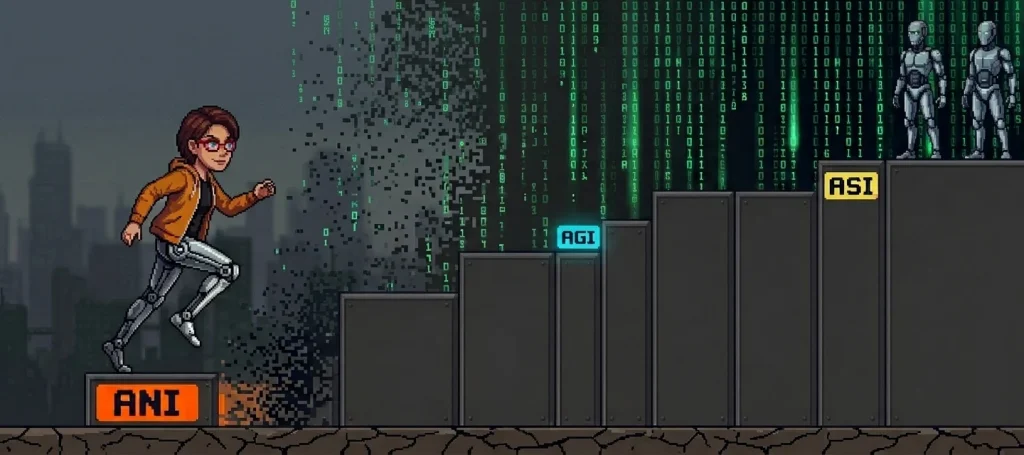
With all that in hand, the full picture of 2026 looks like this: we’re completely surrounded by narrow AI, increasingly capable and increasingly versatile on the surface, but narrow all the same, from your spell checker to the most advanced language model on the market. AGI is still a goal, not an achievement, with a definition still under debate among the people actively chasing it and funding it with billions. And superintelligence remains, for now, the territory of philosophy and informed speculation, a direct heir to a 1965 idea, not something coming out of any lab with a product to show. When you read headlines that blend these three tiers together as if they were the same thing, or that use the word “AI” alone to talk about a spell checker and a hypothetical superintelligence interchangeably, you now have the tools to separate fact from hypothesis.
When something describes a concrete, verifiable capability in a concrete domain, you’re probably looking at narrow AI, however impressive it is. When something talks about an intelligence that matches human intelligence in general, without specifying at what task or under what conditions, you’re in AGI territory, still unoccupied. And when something talks about surpassing all of humanity across every domain at once, you’re reading about superintelligence, an idea with sixty years of serious intellectual history behind it, but zero implementations.
Next chapter, we leave the theory of AI types behind and close out phase 0 with the minimum math you need to understand AI: vectors, matrices, and probability, the toolkit you need before moving into phase 1, classic machine learning.
Sources
- Minds, Brains, and Programs, John Searle, Behavioral and Brain Sciences, 1980 (resumen)
- The Chinese Room Argument (Stanford Encyclopedia of Philosophy)
- Types of Artificial Intelligence (IBM)
- What is Artificial General Intelligence (AGI)? (IBM)
- Beyond big models: Why AI needs more than just scale to reach AGI (IBM)
- OpenAI Charter (2018)
- Superintelligence: Paths, Dangers, Strategies, Nick Bostrom, 2014 (reseña y resumen)
- Speculations Concerning the First Ultraintelligent Machine, I. J. Good, Advances in Computers vol. 6, 1965
- 2023 Expert Survey on Progress in AI (AI Impacts)