APIs are everywhere in our daily lives. When you check the weather on your phone, book a ride, or order food, you are interacting with APIs. Websites that display maps, social media feeds, or shopping carts all rely on APIs to fetch and display data from different sources. They are so ubiquitous that we rarely stop to think about them, until AI enters the picture. AI APIs are what turn a model that only generates text into a system that retrieves real data and takes real action, and that’s quietly made them the most strategic layer of the software stack.
This article dissects what an API actually is, the types and protocols you will encounter in real projects, the security practices you cannot skip, and the role APIs now play in connecting large language models to the rest of the world.
What is an API?
An API — Application Programming Interface — is, at its core, a contract between two pieces of software: it specifies which requests one side may make, in what format, and what data or functionality the other side will return. Think of an API not just as code, but as the invisible digital glue holding the modern software world together: the standardized handshake that lets a legacy enterprise system talk to a cutting-edge AI model.
Two properties make this contract powerful:
APIs are deliberately narrow windows. Each endpoint answers one kind of question with exactly the data that question needs — the server’s internals, and everything not covered by the contract, stay out of reach. That makes an API simultaneously an abstraction mechanism and a security boundary.
APIs are reusable building blocks. Instead of rebuilding payments, maps or authentication from scratch, a developer plugs into someone who already solved the problem — which is why a weekend side project can ship features that once took a platform team.
How an API works: the weather app example
The mental model is a request/response cycle between a client and a server, with the API acting as the bridge.
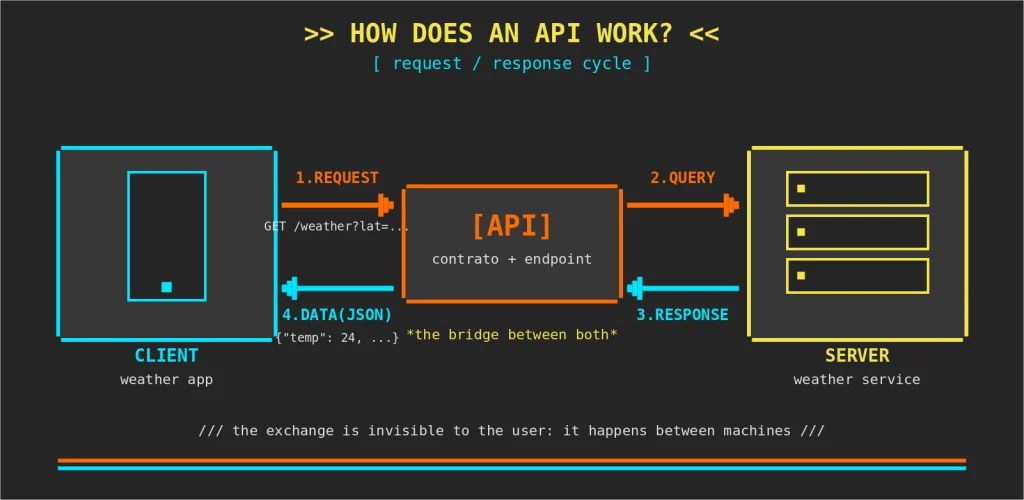
Say you open a weather app on your phone and ask for the forecast at your current location:
1. The app (the client) sends a request through the weather service’s API, addressed to a specific endpoint (a URI), with a request verb, headers and sometimes a body.
2. The API forwards the request to the weather provider’s server.
3. The server processes it and returns a response with the requested data.
4. The API transfers that data back to the app, which renders it on your screen.
None of this is visible in the user interface. The exchange happens entirely between machines, and to the user it just feels like the app “knows” the weather. Third-party payment buttons (“Pay with PayPal”), universal logins (“Sign in with Google”), flight comparison sites and embedded maps all work exactly the same way.
AI APIs: from talking to acting
Here is where the story gets interesting for 2026. A large language model, on its own, can only generate text. APIs are what turn that text generator into something useful.
A helpful image: when a company connects an AI model to its systems, the API acts like a **straw** that feeds the company’s private information into the model so it can answer specific questions — retrieving the status of an order, a customer record, an internal document. This is the retrieval side.
But the more consequential shift is that APIs allow the AI to do more than talk. They let it act on your behalf: booking a flight, sending an email, opening a ticket, updating a database. In modern AI platforms this capability is called *tool use* or *function calling*: the developer defines a set of tools (essentially, API operations with a name, a description and a typed schema), and the model decides when to call them based on the user’s request. The model emits a structured tool call, the application executes the real API request, and the result is fed back to the model to continue reasoning [Anthropic tool use documentation].
In other words: the entire agentic AI wave is, under the hood, an API story. An “agent” is a model in a loop with API access.
Types of APIs
APIs can be categorized by use case. Web APIs dominate today, but they are not the only kind.
Web APIs
Web APIs move data and functionality across the internet on top of HTTP, and they account for the overwhelming majority of APIs in production today. They come in four main flavors, defined by who is allowed to call them:
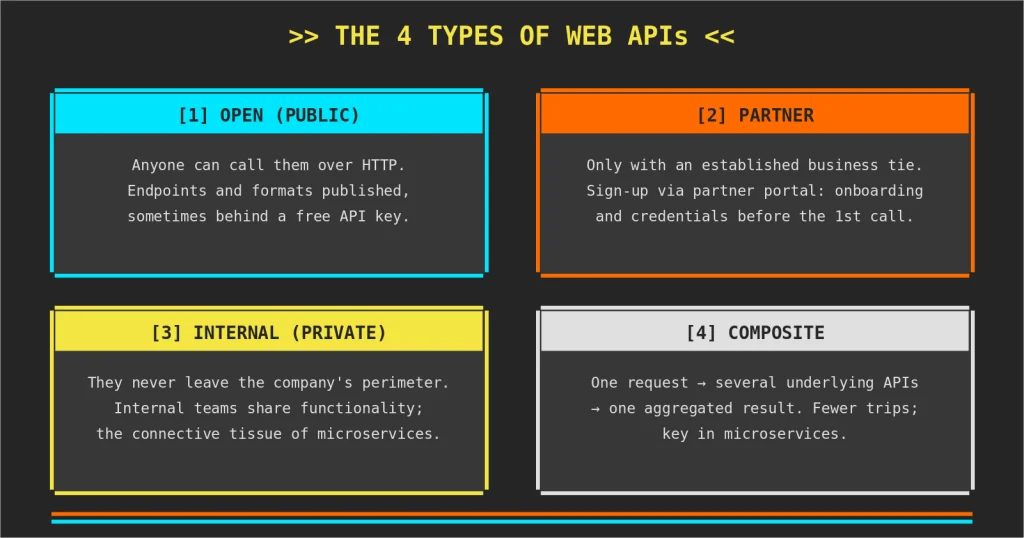
Open (public) APIs: Anyone on the internet can call them. Their endpoints and message formats are published for the world to read, sometimes gated behind a free API key.
Partner APIs: Reserved for organizations with an established business relationship. A developer typically signs up through a partner portal in self-service mode, but has to clear an onboarding process and obtain credentials before making the first call.
Internal (private) APIs: They never cross the company’s perimeter. Their purpose is to let internal development teams share functionality without friction — and, increasingly, to serve as the connective tissue of microservices.
Composite APIs: A single request fans out to several underlying data or service APIs and comes back with an aggregated result. Fewer round trips, which matters most in microservices architectures where one task touches many sources.
Other types
Beyond the web, two families are worth knowing: database APIs, which connect applications to database management systems, and operating system (local) APIs, which define how applications use OS services and resources, file access, notifications, permissions. There are also remote APIs in the general sense: any interface that manipulates resources on another device.
The two big benefits: innovation and collaboration
Strip away the details and APIs deliver two fundamental things:
Innovation: Building on top of existing APIs collapses the cost of launching something new: companies plug into partners and ship services to existing markets without reinventing core capabilities. The canonical example is Stripe, which started as a payments API, famously integrable with a handful of lines of code, and grew into one of the most valuable fintech companies in the world.
Collaboration: Rather than every team duplicating the same functionality from the ground up, APIs let developers wire existing services into new applications and stitch together workflows that span multiple platforms, apps and systems. The average enterprise runs on hundreds of cloud applications; without APIs, they would be disconnected silos.
Protocols and architectural styles
The term “API” once described low-level, language-specific interfaces bound to a particular application. Today’s APIs are a different animal: they vary in architecture and data format but are overwhelmingly HTTP-based, which makes them consumable from Java, Ruby, Python, JavaScript or virtually any other language.
As web APIs proliferated, a set of protocols, styles and frameworks emerged to standardize information exchange, each with strengths and trade-offs:
SOAP (Simple Object Access Protocol): An XML messaging specification that can ride on several transports, HTTP and SMTP among them. Its independence from language and runtime environment, plus strict typing, keeps it alive wherever formal contracts and data integrity are paramount.
RPC (Remote Procedure Call): A paradigm that lets a program invoke a procedure on a remote machine as if it were local, on top of a transport like TCP/IP or UDP.
XML-RPC and JSON-RPC: Lightweight RPC variants using XML and JSON payloads respectively. JSON-RPC’s simplicity has given it a second life, it is the wire format of the Model Context Protocol, discussed below.
gRPC: A high-performance, open source RPC framework originally developed by Google, built on HTTP/2 and Protocol Buffers. A common choice for service-to-service communication in microservices architectures.
WebSocket: Enables bidirectional, persistent communication between client and server — no new connection per message — making it ideal for real-time use cases like chat, live dashboards or streaming model output.
REST (Representational State Transfer): Not a protocol but a set of architectural constraints. RESTful APIs use HTTP verbs (GET, PUT, POST, DELETE) against resources identified by URIs, are stateless, and support multiple formats (JSON, XML, plain text). Simplicity and cacheability made REST the default for public web APIs.
GraphQL: An open source query language and server-side runtime, developed at Facebook in 2012 and open-sourced in 2015. Clients specify exactly the data they need in a single request, solving REST’s over-fetching and under-fetching problems — especially valuable in complex environments with fast-changing front-end requirements.
None of these is universally “better”. REST is easier to implement and cache; GraphQL fetches data more flexibly; gRPC wins on raw performance between internal services; WebSocket owns real time.
API security: non-negotiable
As APIs have become more prevalent, and as autonomous AI agents start consuming them at machine speed, securing them is essential. The baseline practices:
Authentication and authorization: Verify who is calling, and verify what they are allowed to do — on every request, at the object level. Those who need access have it; those who don’t, don’t. It is worth noting that the number one risk in the OWASP API Security is precisely Broken Object Level Authorization (BOLA): endpoints that receive an object ID and act on it without checking that the logged-in user actually has permission over that object.
Encryption: Protect data in transit (TLS everywhere) so payloads cannot be read or tampered with as they move.
Rate limiting: Throttle request volume per client to prevent abuse, brute-force attacks and resource exhaustion — increasingly important when the “client” may be an automated agent in a loop.
Alongside security, developers should follow core design principles: clear and consistent naming conventions, comprehensive documentation (the API’s instruction manual, and a major driver of adoption), and versioning to manage changes over time without breaking consumers.
Where this is heading: the agentic API economy
Everything above was true before the AI boom. What has changed since is who consumes APIs, and a standardization race worth following.
Function calling became a first-class model capability. Major AI platforms expose structured tool use, where models emit typed API calls that applications execute. Recent iterations go further: Anthropic’s platform, for example, now supports programmatic tool calling, where the model orchestrates several tools through code instead of one API round-trip per call [Anthropic engineering blog].
The Model Context Protocol (MCP) standardized the AI-to-API connection. Introduced by Anthropic in November 2024 as an open standard, MCP defines a common way for AI applications to connect to external tools and data sources [Anthropic announcement]. Before MCP, connecting M AI applications to N tools meant up to M×N custom integrations; with a shared protocol, each side implements it once — M+N. Built on JSON-RPC, an MCP server exposes tools and data; an MCP client (the AI app) consumes them. Adoption was remarkably fast: OpenAI adopted it in March 2025, Google DeepMind confirmed support in Gemini shortly after, and Microsoft and GitHub joined its steering committee.
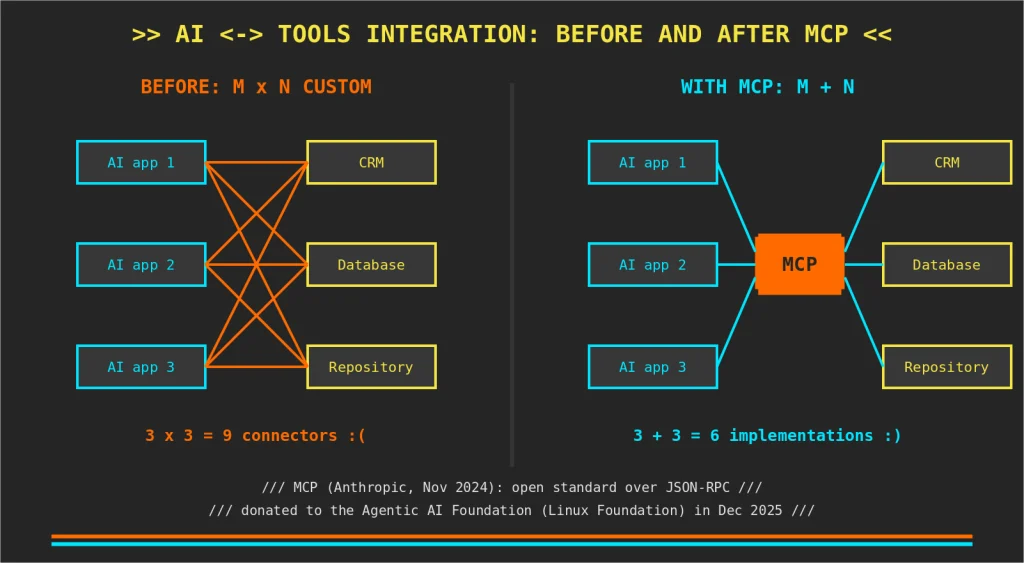
MCP went vendor-neutral. In December 2025, Anthropic donated MCP to the newly created Agentic AI Foundation (AAIF), a directed fund under the Linux Foundation co-founded by Anthropic, Block and OpenAI, with support from Google, Microsoft, AWS, Cloudflare and Bloomberg ([Anthropic], [Linux Foundation]). By then the protocol had reached tens of millions of monthly SDK downloads and thousands of active servers, with first-class client support across ChatGPT, Claude, Cursor, Gemini, Microsoft Copilot and VS Code. The same neutral stewardship model that supports Kubernetes and Node.js now underwrites the AI-tool connection layer.
The takeaway for developers: your API is no longer just an interface for other developers. It is becoming an interface for other people’s *agents*. That raises the stakes on everything in this article — clear contracts and naming (models read your docs literally), strict object-level authorization (an over-permissioned agent is a confused deputy waiting to happen), and rate limiting designed for automated consumers.
Conclusion
APIs simplify how software is built and multiply what it can do — innovation and collaboration, in two words. They enable seamless communication between billions of connected devices, and they are the mechanism by which AI models stop being text generators and start being systems that retrieve real data and take real actions. As AI, machine learning and agentic architectures mature, APIs are quite literally the building blocks and connections of the digital world. Learn to design, secure and document them well; increasingly, your most demanding API consumer won’t be human.
Sources
– What Is an API (Application Programming Interface)? — IBM Think
– Tool use with Claude — Claude Platform Docs
– Introducing advanced tool use on the Claude Developer Platform — Anthropic Engineering
– Introducing the Model Context Protocol — Anthropic
– Donating the Model Context Protocol and establishing the Agentic AI Foundation — Anthropic
– Linux Foundation announces the formation of the Agentic AI Foundation